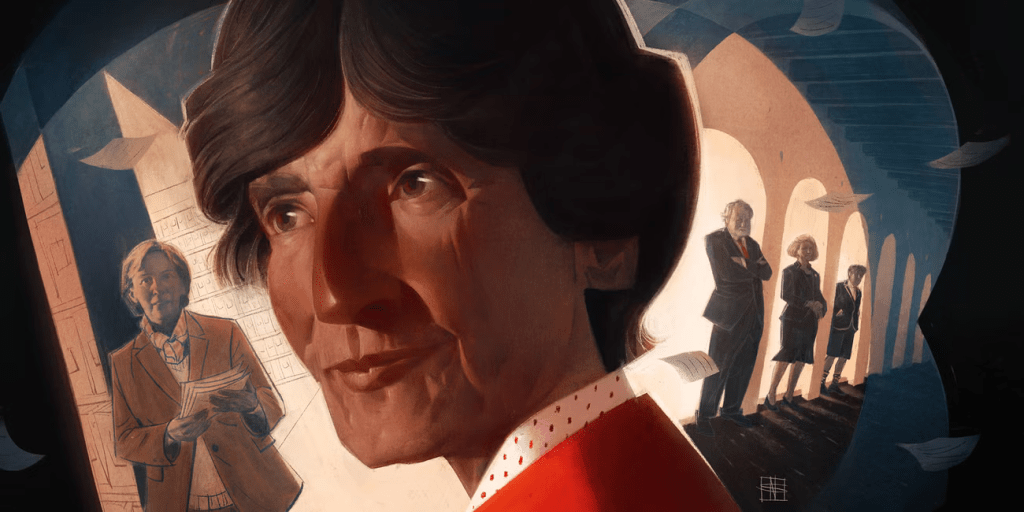
In 2019, Leoncio Alonso González de Gregorio y Álvarez de Toledo, the 22nd Duke of Medina Sidonia, stormed into his late mother’s palace on the Andalusian coast of Spain.
In a video he posted on YouTube marking the occasion, the Duke, tall and silver-haired, strides triumphantly through the Ambassador Room — a grand hall nearly 33 yards long, lined with oil paintings by the likes of Velázquez’s master, Francisco Pacheco. In happier times, the room had been used for receiving dignitaries who visited the Duke’s mother, Luisa Isabel Álvarez de Toledo. Celebrated as the “Red Duchess,” Luisa Isabel was a socialist-minded, fascism-battling aristocrat beloved by ordinary Spaniards. But now, 11 years after she had cut Leonicio and his siblings out of their inheritance, the Duke had arrived at the palace to lay claim to a national treasure he considered his by birthright.
“At last, I’m at home after many decades away,” Leoncio proclaims in the video.
The treasure, known as the Archive of Medina-Sidonia, was housed in the palace’s attic. A collection of 6 million documents, it spans nearly a millennium of Spanish imperial history. Within its pages lie the secrets of the kings, dukes, and explorers of medieval Spain. Luisa Isabel, who had spent the last two decades of her life cataloging the archive, believed it proved that Arab Andalusians, not Christopher Columbus, had discovered America. Perhaps the most important privately held archive in Europe, it is valued at over $60 million, though historians who have studied it consider it priceless.
Luisa Isabel, who’d been imprisoned under the regime of dictator Francisco Franco, believed the archive should pass to the people. “I have inherited this legacy, which is legally mine,” she once declared. “But morally, it belongs to everyone.” In her will, Luisa Isabel left only 743,000 euros to Leoncio and his siblings, Pilar and Gabriel. The bulk of the estate — including the archives — would be controlled by Liliane Dahlmann, Luisa Isabel’s lover and longtime secretary, whom the Duchess had married on her deathbed.
The fight over the priceless archive — one of Europe’s most important private collections — has been “the stuff of nightmares.”
What ensued was a bitter legal battle that would shatter the family, captivate Spanish society, and throw the fate of the archive into doubt. Leoncio’s homecoming video was a declaration of war. Flouting a court ruling that barred him and his siblings from living in the palace, he had decided to move back into his ancestral home — even though it was legally occupied by Liliane, his mother’s widow. “There’s a lot of tension,” says Gabriel. “They barely talk to one another, enter and leave through separate doors, and rarely bump into one another.” To drive home his disputed claim, Leoncio made a point of interrupting weekly palace tours. “Welcome to my house!” he would greet groups of startled tourists. “Here, they only manipulate the truth.”
Liliane, ensconced upstairs with the archive she had been charged with safeguarding, kept her silence. At times it must have seemed that the family’s inheritance, passed down through the generations and now entrusted to her care, was cursed. “Sometimes you don’t choose your destiny, it chooses you,” she once said. “Personally, these past few years have been exceedingly difficult — the stuff of nightmares.”
The family appeared to start off happily enough. In 1955, only 18 years old and already pregnant with Leoncio, Luisa Isabel married José Leoncio González de Gregorio, a nobleman from Soria. Photographs from the time show the new Duchess smiling in a black ankle-length dress, her long hair framing her tiny face and her lips brightened with lipstick. Standing beside her, José Leoncio appears tall, athletic, and handsome.
In reality, Luisa Isabel and José Leoncio couldn’t have made a more ill-suited couple. Her ancestors had commanded Spanish armadas, served as prime minister, and owned vast swathes of southern Spain. Her parents had fled the country during the Spanish Civil War. Her new husband, by contrast, was a die-hard conservative who supported Franco’s dictatorship. Luisa Isabel loved the night life. José Leoncio, a man of the countryside, disliked high society nearly as much as the radical ideals that would soon claim his wife.
During their brief union, the couple had three children in quick succession: Leoncio in 1956, Pilar in 1957, and Gabriel in 1958. But the Duchess never seemed to take to the role of mother. After giving birth to Gabriel, family lore has it that she handed him to the nurses and declared she had fulfilled her role as a woman. The moment also marked the end of her marriage. Within the year, she had separated from José Leoncio and began to spend long stretches in Paris, where she mingled with Simone de Beauvoir and other leading intellectuals. Her children remained behind in Madrid, where they were left in the care of Luisa Isabel’s grandmother. “She rarely came to visit,” Gabriel recalls.
One day, when Gabriel was 6 or 7, his mother appeared at the door. Gone were her elegant dresses and long hair. Wafer thin, Luisa Isabel now sported men’s trousers and short-cropped hair. There were rumors she was sleeping with women. “Someone in the household said she was our mother,” Gabriel recalls. “But for us, she looked like the boy who worked at the local grocery.” Leoncio was distraught. “You’re not my mother!” he cried.
The change in Luisa Isabel ran deeper than fashion. In 1964, the Duchess led a protest march of fishermen in Sanlúcar. Her noble pedigree gave her a measure of protection to speak out against Franco. “This privileged aristocrat had a rebellious spirit,” as one newspaper put it. Her reputation was further cemented in 1967, when she stood up for a group of protesters whose homes had been rendered radioactive after an American nuclear bomber crashed over the small fishing village of Palomares. The protesters, she told soldiers dispatched by the regime, “are here only for justice, and they are here with me.” She then led the group to a bar at the village’s main square for a round of cold beers.

Arrested and thrown in prison for a year, the Duchess kept up the fight from her miserable, rat-infested cell. She wrote letters and articles denouncing the conditions in Spanish prisons. A novel she authored about suffering farm workers called “The Strike,” which she had managed to smuggle into France, prompted the government to threaten her with a 10-year sentence for slander. In April 1970, a few months after her release, the Duchess escaped to France disguised as a man. “I remember putting the hat and the mustache on her,” recalls Julia Franco, a longtime family employee.
During her exile, José Leoncio seized on her political dissidence to secure custody of the children. “The role of being a mother slipped away from her,” Pilar recalls. According to Gabriel, he and his siblings were at their father’s mercy. “He was determined to redirect our lives, banning the staff from passing her calls or letters on to us,” he says. The children, by birth, were nobility. But their lives felt anything but noble.
Read the rest of the article at: https://www.businessinsider.com/spanish-aristocrats-fighting-over-family-priceless-inheritance-red-duchess-estate-2024-12
 Matthew Bremner: Journalist