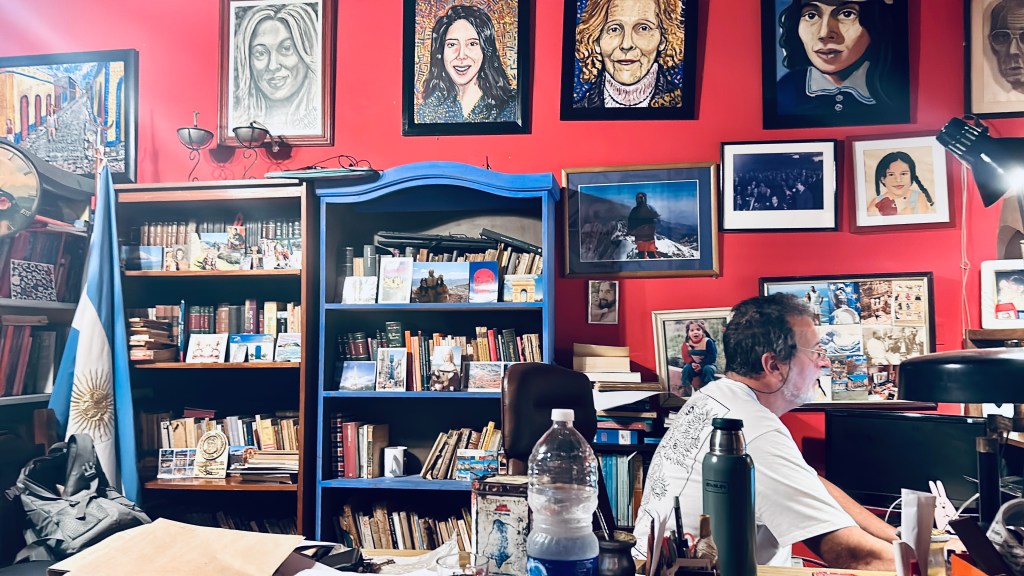
That morning, like every morning, Javier Garín’s home office was dimly lit. His hulking wooden desk was cluttered with case files and ring binders, watched over by the celestial blue and white of the Argentine flag hanging in the corner of the room. On the bookshelves behind him were heavy legal texts, pictures of Eva Perón, and family portraits that he had painted. As he waited for his next meeting, the warmth of the radiators thickened the heavy, humid air of winter in Buenos Aires. Garín, then in his late fifties, was well over 6ft tall with greying hair and a booming voice. He lived in the upper-middle-class neighbourhood of Banfield, a patchwork of large houses and bungalows lined with lush trees and bumpy pavements.
Garín had been a lawyer for 30 years, spending much of his career battling a gamut of issues, from suspected sect leaders to police corruption. But he had always been political, and the cases that most fascinated him were human rights cases linked to the country’s last dictatorship. In power from 1976 to 1983, a series of military juntas had kidnapped, tortured and murdered leftwing activists, intellectuals, students and suspected dissidents. Thousands more simply disappeared.
While there were a series of trials in the years following the regime’s collapse, successive governments decided to shield perpetrators with impunity laws. It wasn’t until the new millennium that Argentina began to grapple with its past in earnest, prosecuting former military officials for human rights crimes and paying compensation to victims. Garín had worked on some tough cases during that period — including disappeared children — and felt he’d seen and heard everything. He was about to find out he hadn’t.
It was June 2016, and Garín was due to meet with Adrián Martínez Moreira. Moreira had graduated with a degree in sociology from the University of Buenos Aires and was well known among the activists and organisations dedicated to locating the children of those who had vanished during the dictatorship. Moreira claimed to be the son of disappeared parents. His birth parents had been abducted in 1988 under the dictatorship of Alfredo Stroessner in Paraguay. In his retellings, Moreira and his sister had been kidnapped by an Argentine soldier named Héctor Jorge López, who’d renamed the young boy Matías Ezequiel López. In 2014, Moreira convinced the courts of his story and restored his real name.
Moreira’s story had appeared on the front pages of periodicals in Argentina. In an interview for an article published in the leftwing newspaper Página 12, he explained how tragedy followed him: first, the kidnapping of his parents and, more recently, being sexually assaulted for his activism. Moreira, who was openly gay, also revealed that his husband had died in a train accident in 2012. “Adrián’s story seems to be the fruit of a feverish soap operatic mind,” the article began. “It can’t be true, it shouldn’t be . . . ”
At the time of their meeting, Garín was only vaguely aware of Moreira’s past. They had first met when Moreira came to him for help two years earlier. Garín was always giving free consultations to victims. Still, back then, something about Moreira had seemed off. The most noticeable incongruity, if he could call it that, was that Moreira didn’t seem old enough to be the son of disappeared parents. He should have been in his late thirties or early forties. Instead, Moreira looked barely 25. Garín had ultimately declined Moreira’s request for pro bono help.
Garín’s suspicions resurfaced in 2016, when a colleague showed him copies of documents bearing his signature. Garín had no recollection of signing the paperwork, which mainly consisted of endorsements of compensation claims on behalf of dictatorship victims. Garín and his colleague came to suspect that the sloppily composed legal files had been fabricated by Moreira, potentially jeopardising their reputations. Now Garín wanted answers.
He watched as Moreira shuffled into his office. When they had spoken on the phone the previous day, Moreira had denied everything. He’d followed up, insisting he could explain everything in person. Moreira was slight, with long, dark hair down to his shoulders. He spoke in a high-pitched voice and was overly polite, sheepish even, according to Garín’s recollection. (Moreira’s lawyers declined multiple requests for comment on the allegations in this article. Moreira did not respond in time for publication.)
The lawyer got straight to the point: “Did you sign these documents in my name?”
Moreira’s knee bounced under the table. “It’s all here,” he said, reaching into his bag and pulling out a folder. “So you understand what happened.”
“But what is this that you’re bringing me?” Moreira pushed the papers towards Garín, adding that they were from a well-known human rights lawyer.
Garín’s expression darkened. “What I’m asking is this: ‘Did you submit documents with my signature?’”
“No.”
“Who filed them, then?”
Moreira, Garín says, claimed that he’d been duped. That another lawyer, Pablo Llonto, had forced him to sign the documents.
Garín doubted this. Llonto was renowned in Argentina for representing victims in some of the country’s most significant human rights trials. Why would he make Moreira sign these documents in Garín’s name?
“So, you’re saying that this person forged my signature?” Garín asked.
The lawyer recalls Moreira prevaricating apologetically. It was then that Garín experienced a wave of anxiety as he realised that the fraudulent signatures — no matter how they’d actually originated — could destroy the reputation he had worked decades to establish.
Read the rest of the article here: https://on.ft.com/3JLzXw1
 Matthew Bremner: Journalist